 |
 |
How about the
difference between fire ants and termites?
|
 |
Some forms of winged fire ants are
often confused with termitesespecially during termite swarm
seasonbut there are recognizable differences. The front pair
of wings on ants is larger than the hind pair, while the four wings
of termites are approximately the same size. Also, ants have elbowed
antennae and a curvy thin waist, whereas termites generally
are single-shaped and their antennae are straight and hair-like.
|
 |
 |
Where are red
imported fire ants from?
|
 |
In the 1930s, fire ants from South
America entered the United States through ports in Mobile, Alabama,
probably carried in by soil used for ships ballast.
|
 |
 |
How did they
get to where they are today?
|
 |
By nature, red imported fire ants are
aggressive and competitive. They have been spreading in all directions
in the southern areas since the 1950s.
|
 |
 |
Are
they still spreading?
|
 |
Yes, fire ants are moving west, north,
and south, too, and the entire Pacific Coast is fertile ground for
infestation. However, the northward spread depends on warm temperatures
because cold winters tend to push ants back. Western spread, meanwhile,
depends on water because ants seek out a moist climate.
|
 |
 |
Why do fire ants
appear to sting at the same time?
|
 |
Fire ants are extremely sensitive to
vibration and tend to sting when the object they are on moves. The
sting of a single ant causes a person to move or jerk quickly and
thus triggers many other ants on the person to sting in response,
making it appear like a simultaneous action.
|
 |
 |
Is their sting
lethal?
|
 |
Only to a very small portion of the
population who experience severe allergic reactions.
|
 |
 |
What should I
do if I get stung by a fire ant?
|
 |
Treat stings from fire ants as you
would any other insect sting. Keep the area clean and intact to avoid
secondary infection. Watch for excess swelling, itching, redness or
other symptoms such as shortness of breath, thickening of the tongue,
sweating, etc. which could indicate a systemic allergic reaction.
|
 |
 |
What if I have
an allergic reaction?
|
 |
Seek medical attention immediately.
|
 |
 |
Can they be eradicated
completely?
|
 |
Using todays methods, red imported
fire ants cannot be eradicated completely but can be controlled within
confined areas with proper methods and ongoing treatments. |
 |
 |
Can I rid them
from my yard?
|
 |
Yes, but no method is permanent. The
ants often reinvade with new colonies within a year. Thus, annual
treatment should be maintained even if your yard has no visible mounds.
|
 |
 |
Its been
dry and I dont see them. Are they still around? Do I still have
to treat?
|
 |
Heat and drought prevent fire ants
from making mounds, but they are still deep in the ground during the
daytime and foraging for food at night. During these conditions, they
create more of an indoor problem as they go after food and water wherever
they can get it. Yes, you should still treat, especially because the
ants are already in a weakened state. A late afternoon or evening
treatment will work best when ants emerge in the cooler temperature.
|
 |
 |
Do baits work?
Dont they take long?
|
 |
Baits
do work. Most experts recommend bait over so called "contact
insecticides." Properly applied, baits provide the best long
term control of fire ants. Amdro is the fastest acting bait and normally
destroys the colonies in about a week.
|
 |
 |
What is a broadcast
treatment?
|
 |
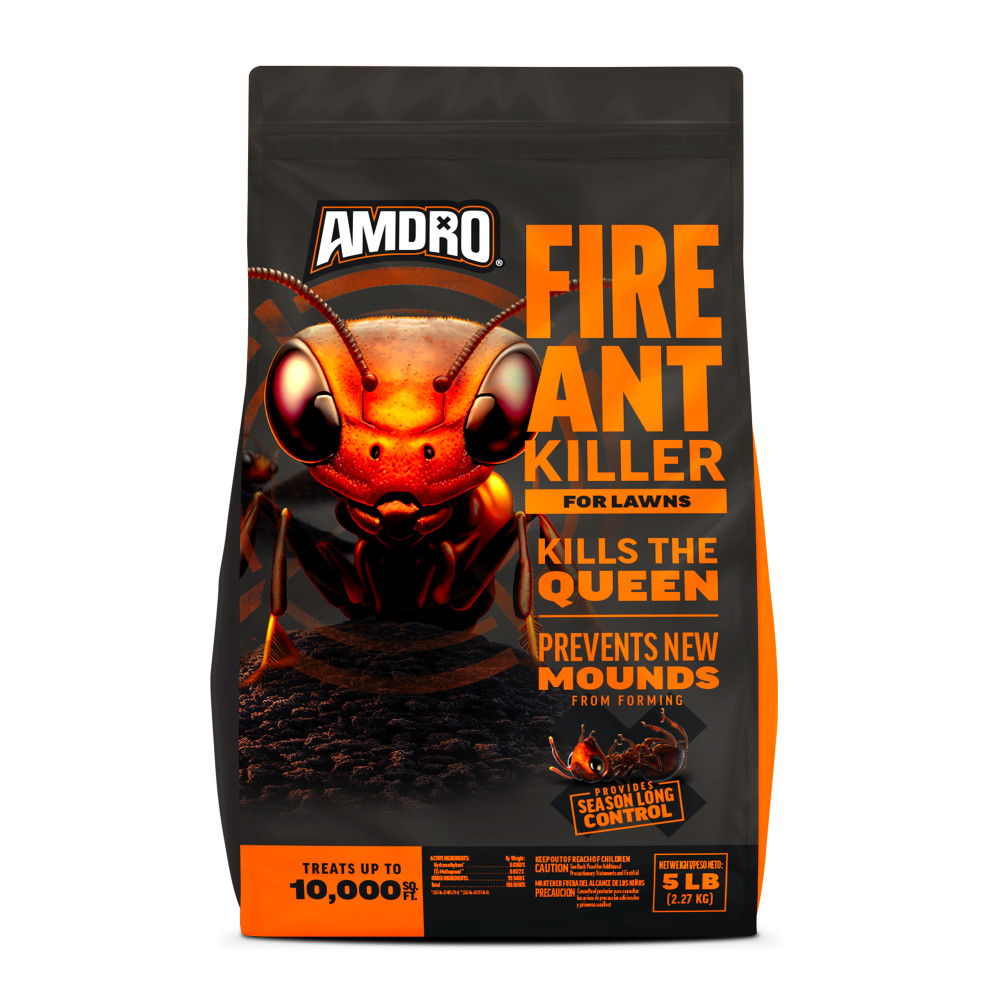
Broadcast treatments are applications
that cover the entire yard using a disk spreader, not just spot treatments
of individual mounds.
|
 |
 |
If I put out
the bait, how often should I reapply, and when?
|
 |
The height of fire ant activity is
in early spring and again in the fall, but you should treat fire ants
whenever they are active.
|
|